Showing posts with label saints. Show all posts

Saturday, October 22, 2011

JPII- The Polish Pope

Happy first feast day of Blessed Pope John Paul II! What a day! It has always been my dream to summarize one of the most prolific pontificates in the history of the Church in one blog entry. Not. But alas, I will attempt to give you a few of the major highlights of Blessed John Paul II's reign as successor of the Chair of St. Peter.

In 1978, after the very short papacy of Pope John Paul I, Karol Cardinal Wojtyla was chosen to be his successor, to the surprise of mostly everyone in the Church. There was something very different about him from the beginning. He was the first non-Italian Pope in 445 years, he denied the papal tiara, and he also broke tradition by addressing the crowd gathered in St. Peter's Square:

"Dear brothers and sisters, we are saddened at the death of our beloved Pope John Paul I, and so the cardinals have called for a new bishop of Rome. They called him from a faraway land – far and yet always close because of our communion in faith and Christian traditions. I was afraid to accept that responsibility, yet I do so in a spirit of obedience to the Lord and total faithfulness to Mary, our most Holy Mother. I am speaking to you in your – no, our Italian language. If I make a mistake, please forgive me…"
The Church knew this was the beginning of something incredible.

JP II was more traveled than any other Pope in the history of the Church. He made the decision that He needed to go out and meet the people that could not come to the Vatican, to "bring the Vatican to them." He traveled to 129 countries. That's a lot. And when he traveled, people showed up. In fact, the largest ever crowd assembled in human history at one time for one specific event is claimed to be the closing Mass at World Youth Day in the Philippines, where an estimated 5 million plus people were in attendance.
Speaking of World Youth Day, he started that too. In 1984, he invited youth from around the world to gather in Rome for a week of prayer, catechesis, and fellowship. It continues to this day, and the next one is in Rio De Janeiro in 2013 .

Another cornerstone of JP II's pontificate is his Theology of the Body (TOB for short). TOB was the topic of 129 of JPII's Wednesday papal audiences (from 1979-1984). It is essentially his integrated vision of the human person-body, soul, and spirit. It revolved around the philosophical concept of the human person as gift. Man was made to give of himself to another, and human sexuality can only find its true meaning in light of that truth. I would expound upon this but there are many folk much more intelligent than I who have already done so. So if you are interested in more, I will bow to their brilliance and point you here.

JP II was also known for his love for the giants that had gone before him. He canonized many of our beloved saints, including the likes of St. Maximilian Kolbe, St. Juan Diego, St. Pio of Pietrelcina (formerly known as Padre Pio), St. Theresa Benedicta of the Cross, and 478 others. Not kidding...478.

He saw sainthood as something achievable for every human on Earth, and often spoke of each individual's call to the heights of holiness. He expected greatness from his flock. It seems that all that the body of Christ needed was to be encouraged and called to something more, and He did just that. This invitation of his manifested in what he called the New Evangelization. JPII saw the severe lacking of evangelistic efforts in the Church, and so he proclaimed:
"I sense that the moment has come to commit all of the Church’s energies to a new evangelization…No believer in Christ, no institution of the Church can avoid this supreme duty: to proclaim Christ to all peoples.”

FOCUS was born as a response to the New Evangelization, and seeks to fulfill Christ's Great Commission re-promulgated by JP II's commission of the New Evangelization. Full circle.

On April 2, 2005 our beloved Blessed Pope John Paul II spoke his last words "Let me depart to the house of the Father," and soon thereafter entered into his final rest. And alas this humble gentle giant who changed the world through his response to God's call in his life and through his unending charity and care for all of humanity received his heavenly reward: eternal bliss. Let us not forget his example of a life "hidden with Christ" (cf. Col 3:3), and let us never tire in responding to his New Evangelization by bringing the love and truth of Christ to the ends of the earth. Let these words forever ring in our ears:
"Do not be afraid of presenting Christ to someone who does not yet know Him. Christ is the true answer, the most complete answer to all the questions which concern the human person and his destiny. Without Christ, the human person remains an unsolvable riddle. Therefore, have the courage to present Christ!"
Blessed Pope John Paul II, pray for us, that we may see the face of Christ!

By Guest Blogger Austin Ashcraft, FOCUS Missionary


Friday, October 21, 2011

JPII - The Path to the Papacy

As we mentioned yesterday, by the age of 20, Karol had suffered the death of his mother, brother, and father. He was now the only remaining member of his immediate family. I remember when I heard this the first time, I was stunned at this fact. I could not imagine losing a single member of my family by that age, much less every single one. I thought to myself, why would God allow such suffering and pain to happen to this young man who He had such great plans for? One word: detachment. Our Heavenly Father, in his infinite and unrelenting passionate love for Karol, stripped him of all earthly things he could possibly cling to so that Karol had no other choice but to cling to his Father in heaven who alone can satisfy his deepest desires. God was completely detaching him from everything to prepare him for sainthood.

Karol recognizes this initiative on God's part and responded quickly. Soon after his father's death, he spoke of the clarity and the inner conviction of his calling to the priesthood. At the age of 22, Karol entered the seminary in Krakow. He had an eventful four years there, including the 1945 German invasion of Krakow causing heavy damage to the seminary. After the Germans left, Karol and a friend volunteered for the delightful chore of cleaning up the frozen excrement from the lavatories (talk about consecrating the mundane...). Later on that year on All Saint's Day, Karol was ordained a priest of Jesus Christ.

Karol quickly set himself apart due to his love for academics and his natural intelligence. During the early years of his priesthood he earned both a doctorate in sacred theology and philosophy. Pope Pius XII saw the incredible amount of potential in young Wojtyla and in 1958 while Wojtyla was out on a kayaking trip, he was appointed auxiliary bishop of Krakow . At the age of just 38, Karol became the youngest bishop in Poland (6 years later he was appointed primary Archbishop of Krakow).

As bishop, Karol played an important role in the Second Vatican Council. He was a main contributor to both Dignitatis Humanae and Gaudium et Spes. Both of these documents were influential to the Church after Vatican II and are still of great significance for us today. Being a big proponent of life and the dignity of every human life, he also was instrumental in the formulation of Pope Paul VI's Humanae Vitae. In the midst of all of this theological writing, Karol was still known for his presence to the person in front of him and his incredible attentiveness and love he showed to each person that he met. He never lost his wonder and awe for the human person, which finds its meaning only in the person of Jesus Christ.

In 1967 he was promoted to the Sacred College of Cardinals, which would be his last promotion before his election to the Chair of St. Peter...

By Guest Blogger, Austin Ashcraft, FOCUS Missionary


Thursday, October 20, 2011

JP II - The University Student

We continue our series on Blessed John Paul II's life as we prepare to celebrate his first feast day on October 22nd.

Today, we look at Karol Wojtyla's (JPII) life as a university student. This was by far some of his most formative and life changing years.

Karol Wojtyla enrolled at Jagiellonian University in Krakow, Poland to pursue literature and theater and quickly continued his academic success. But, Karol's path would soon be disrupted by Germany's invasion of Poland and the start of WWII. For Karol, the war was not something out there. It intimately affected his own life and those around him. The German occupation brought fear, bloodshed, poverty, and death. 184 professors from Jagiellonian University were arrested. 3,646 Polish priests and 1,117 nuns were sent to concentration camps. One third of all Polish clergy were killed during the occupation.

Karol continued his studies in secret and was a part of a understand cultural movement to keep Polish culture alive. He also met a man who would have a deep impact on him, Jan Tyranowski. Through Living Rosary small groups, Jan helped Karol develop a deep prayer life and sent him out to lead other groups as well.

At this time, Karol was a manual laborer at a chemical plant. The work was difficult but the travel to his job was enough of a sacrifice. On his walk to the plant, Karol would put petroleum jelly on his face to keep it from freezing during the winter. This wouldn't be Karol's greatest struggle. Having already lost his mother and brother before, his father passed away during this time, leaving Karol the only remaining member of his family.

Amid the madness of the German occupation, many despaired, lost hope, or turned to violence. Karol had a different reaction. In the face of such tragedy and with the help of Jan Tyranowski, Karol slowly brought himself to a place of what he called "inner illumination." Karol became progressively detached from his earlier plans of acting and turned his thoughts towards the priesthood. While seminaries were underground and clergy were being arrested left and right, Karol still felt a calling to give his life in the face of such despair.

--

Tomorrow, we will look at what JPII was like as a priest.


Detachment from his earlier plans

Tuesday, October 18, 2011

6 Blessed John Paul II quotes that changed the world

The First Feast of Bl. John Paul II is on Saturday October 22nd, but there is no reason to wait until then to start celebrating. Here are 6 JPII quotes that changed the world:

1. Proposing the New Evangelization: There is a situation... “where entire groups of the baptized have lost a living sense of the faith, or even no longer consider themselves members of the Church, and live a life far removed from Christ and his Gospel. In this case what is needed is a ‘new evangelization’ or a ‘re- evangelizaiton.’”

2. Articulating the Theology the Body: “Man cannot fully find himself except through the sincere gift of self.”

3. His closing statement at the opening Mass of his Pontificate: “Do not be afraid.”

4. Preaching the Gospel in the modern world: “The question confronting the Church today is not any longer whether the man in the street can grasp a religious message, but how to employ the communications media so as to let him have the full impact of the Gospel message.”

5. The defense of life and family: “As the family goes, so goes the nation and so goes the whole world in which we live.”

6. On having joy in the Christian life: “Do not abandon yourselves to despair. We are the Easter people and hallelujah is our song.”


What's your favorite JPII quote or memory?

Tuesday, October 4, 2011

Did Francis really say, “Preach the Gospel at all times and if necessary use words”?

As Catholics, we have a number of phrases and sayings we use with one another on a consistent basis. One of the most common sayings is “Preach the Gospel at all times, and if necessary use words.” This quote is popularly attributed to St. Francis of Assisi. The saying is often used as a recommendation for how we should primarily or even exclusively evangelize. But, did St. Francis of Assisi really say this? And, did he really live this out as his primary means of evangelization?

Well, the truth is, there is no evidence that St. Francis said this. It is clear that St. Francis’ life and actions did provide a great deal of evangelization on their own. In the context of a society where many clergy lived extravagant lifestyles, St. Francis’ vow to poverty was a stunning image of the Gospel.

And yet, what is often lost amid a portrayal of a man who is usually pictured with animals is a saint who was not afraid to preach the Gospel verbally to others. It was said that he would go to the extravagant parties of the rich and preach the Gospel to them. When walking the paths of Assisi, St. Francis would often preach the Gospel to those he met. In fact, St. Francis is pictured with birds because the story goes that St. Francis even preached the Gospel to them. If he went so far as to preach to birds than surely he wasn’t afraid to preach to the men and women he met.

There is no doubt that our lives should proclaim the Gospel. But, we should also be able to articulate the Gospel to others. As Pope Benedict says in Verbum Domini, "It is not a matter of preaching a word of consolation, but rather a word which disrupts, which calls to conversion and which opens the way to an encounter with the one through whom a new humanity flowers (no. 93). St. Francis lived this both/and rather than an either/or. If he did ever say, “Preach the Gospel at all times and if necessary use words” then he must have thought it was necessary to do so on a consistent basis.


Friday, September 30, 2011

Wait, why is a cloistered nun the patroness of a missionary organization?

St. Therese is the patroness of FOCUS and October 1st is her feast day. St. Therese is one of the most popular saints and at first glance making her FOCUS’ patroness seems like a pretty normal thing to do...until you really think about. Why would an organization dedicated to missionary work chose a patroness who spent the entirety of her adult life in a convent far away from missionary work?

Three reasons

1. She prayed for and wrote to missionary priests.
When assigned to two missionary priests, she told her superior, “Mother, I did not know how to express my happiness.” She wrote to one missionary priest, “Let us work together for the salvation of souls…what encourages me is the thought that by your side I can be of some use.”
While it is helpful for the patron or patroness of an organization or cause to relate directly to it , the job of a patron or patroness is to provide prayer intercession. (St. Francis Xavier and St. Therese are the patron saints of missionary work and FOCUS).


2. She had an incredible heart for missionary work.

St. Therese once said, “I have the vocation of the Apostle (Paul). I would like to travel over the whole earth to preach Your Name and to plant Your glorious cross on infidel soul. But…one mission alone would not be sufficient for me, I would want to preach the Gospel on all the five continents simultaneously and even to the most remote isles. I would be a missionary, not for a few years only, but from the beginning of creation until the consummation of the ages.”


3. She sought to save souls through her own pursuit of holiness.

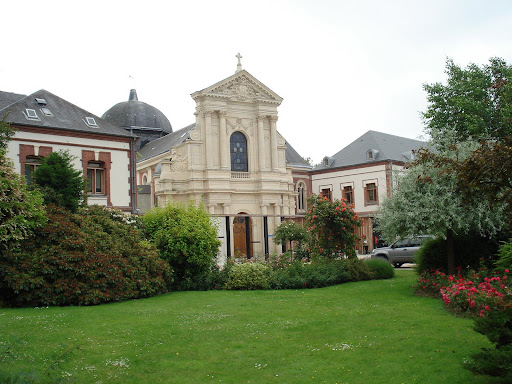
One author writes, “The religious life seemed to her primarily a means of saving souls. She even thought at one time of becoming a nun in the foreign mission; but the hope of being able to save more souls by penance and sacrifice was responsible for her decision to enclose herself in Carmel.” (Carmel pictured left).

St. Therese’s missionary work continues today through others following her example and through her intercession.

St. Therese, pray for us.


All quotes are from St. Benedict & St. Therese: The Little Rule and the Little Way by Dwight Longenecker.


Thursday, August 11, 2011

Why Dead People Matter Part 2 - Why do we have relics again?

This continues our series on the recent report that archaeologists found the Apostle Philip's tomb.

If St. Philip's tomb is verified, pilgrims from all over the world will come to see and be near an Apostle of Jesus Christ.

But, why is this a tradition in the Catholic Church? Why do we love relics and dead bodies so much?

In the United States, we do not have too many relics exposed for viewing. But, if you have been to Europe, you can't help but see relics all over the place. For instance:
  • St. Francis Xavier's hand is in encased on the wall of the Gesu Church in Rome.
  • St. Catherine of Siena's head is encased for viewing in a Church in Siena while her body resides in a Church in Rome.
  • St. Vincent de Paul's incorruptable body is on display in Paris (picture on right).
So, why again do we do this? Why do we care so much about dead people? Why do we need to touch them? Isn't this all just a little freaky.

Well, let's let Sr. Mary Gabriel from the Sisters of Life explain from this one and a half minute audio clip from our last FOCUS Conference.


Material things can become holy. Jesus turned natural materials like bread and wine into something supernatural--His own body and blood. He used earthly things like mud to heal the blind. And, He is taking earthly things like ourselves and slowly making them into Himself. Our goal is to be like Him not in a vague sense, but in a tangible one. The saints are a visual witness to this. For St. Philip who lived with Jesus, this reality is even more...well, real.

For an article on the different types of relics and where you can find them go here.


Monday, August 8, 2011

Why Dead People Matter Part 1 - What It Means to Follow Jesus

Last week archeologists announced the discovery of what is believed to be the tomb of St. Philip the Apostle. The discovery of an Apostle's tomb is amazing!

The Apostles' tombs

Throughout the history of the Church, the veneration of saints' tomb, e
specially the Apostles has been done with great devotion. For instance, in the middle ages, Christians flocked to the tomb of St. James in Spain. People would travel from all over Europe and spend a considerable amount of time and money just to come to see his tomb. This is still done today. FOCUS Missions leads a trip on the Camino de Santiago (The Way of St. James) each year. The tombs of Sts. Peter and Paul are also very popular pilgrimage sites today.

Does it matter?
But, in the wake of the discover of St. Philip's tomb, there has not been too much news or excitement about the discovery. If you search "St. Philip's tomb" in Google News, just 49 articles appear. As a comparison, a story about an asteroid in Earth's gravitational pull garnered over 400 news stories.

I think it's important to ask: Is the discovery of St. Philip's tomb significant? In other words, does finding a dead person's tomb still matter?

In this first part, I want to look at the story of St. Philip and its ability to bring to mind the historical reality of Jesus. St. Philip is a man who followed and lived with Jesus. A man who witnessed Jesus' miracles, death, and resurrection. A man who lived out Jesus' commission to make disciples of all nations. And, a man who would be martyred for his witness to Jesus Christ.

St. Philip's story
St. Philip was one of Jesus 12 Apostles. He was from Bethsaida, a small and insignificant town in the backwaters of Galilee (also, the home of Sts. Andrew and Peter). The account of when Philip first started following Jesus is found in the Gospel of John (John 1:43-51).


St. Philip is mentioned a few times in the Gospels but mostly in passing. We do have a significant amount of information about St. Philip outside of the New Testament although not all of it can be trusted historically. It is believed that St. Philip preached in Greece, Syria, and Turkey. Most sources claim that St. Philip was eventually martyred in Turkey in the city of Hierapolis (where his tomb was recently found).

While we are not exactly sure about all the details of his life, his witness and martyrdom still echos as a testament to his dedicated following of Jesus. In the video below (especially the first three minutes) Rob Bell*, a Protestant pastor, does a great job of capturing some of alleged details of St. Philip's life. He describes what it meant for St. Philip to follow after Jesus 2,000 years ago and what it might mean for us today as we follow Jesus.

What do you think about the discovery of St. Philip's tomb? Why do you think that there has not been much news or excitement about this discovery?

Rob Bell on St. Philip


* I personally find Rob Bell to have a incredible ability to bring the past come alive. At the same time, neither I nor FOCUS endorse or support all of Bell's teachings.