
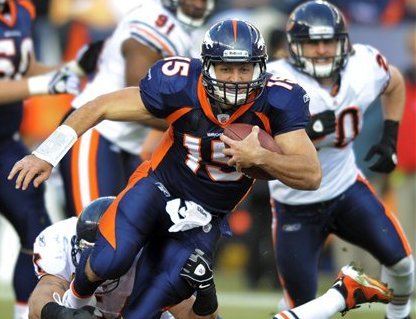
 "They said I couldn't be a high school quarterback. They said I couldn't get a D-1 scholarship. That you can't make it. That you're not good enough. That you're not skilled enough. They said I couldn't win a Heisman. They said I couldn't win a national championship. They said I wouldn't be a first round draft pick. They said I couldn't play in the league. 'Preciate that."
- Tim Tebow in a FHS commercial
The story of Tim Tebow is filled with people who have doubted him. The doubts continue and yet Tebow finds success. How does he do it? How does he overcome adversity? What makes him a champion?
I would like to propose that Tim Tebow's
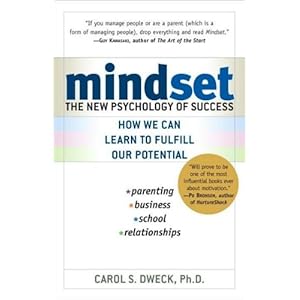 mindset makes the difference.
In her book, Mindset: The New Psychology of Success, Dr. Carol Dweck talks about two different kinds of mindsets, a fixed mindset and a growth mindset.
A fixed mindset says:
1. Your intelligence is something very basic about you that you can't change very much.
2. You are a certain kind of person, and there is not much that can be done to really change that.
3. You have to be perfect. Failure is not an option.
4. Hard work is for those who don't have what it takes.
A growth mindset says:
1. You can become more intelligent over time.
2. No matter what kind of person you are, you can always change substantially.
3. Failure is an opportunity for growth.
4. Hard work is necessary for anyone to succeed.
Tim Tebow embodies a growth mindset.
Tebow does not have all of the talent in the world. His throwing motion is unconventional. His throwing accuracy is well below other top quarterbacks. This is why NFL commentators and analysts have doubted Tebow from day one. But, what they don't realize is that Tim Tebow knows how to improve and he has been improving his whole life. He isn't worried about failure. He isn't worried about looking bad. He is worried about improving and working hard. He has a mindset to overcome adversity. His teammates consistently remark that they have never seen someone work as hard as Tim Tebow does.
 In college, Tim Tebow had incredible success. But, during one season, his team had an unexpected loss that ruined the opportunity for a perfect, undefeated season. Listen to Tebow's response:
 And, Tebow's attitude has changed his entire team. When he took over the team, the Broncos
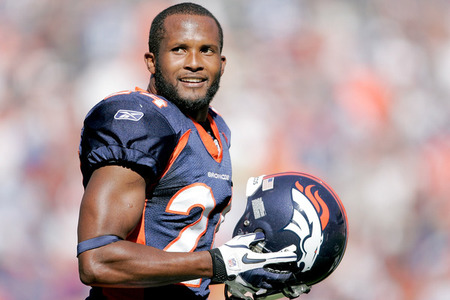 had a 1-4 record. Since Tebow has been at quarterback, they have been 7-1. The level of play by the entire team has risen. Champ Bailey (picture on right), who has played for 13 seasons and will almost certainly be a Hall of Fame cornerback said this, "Tebow is a special player. I have never seen a player quite like him in my whole career! I'm gonna play all out for the guy! I know he will be out there giving 110% every play every week, so I'm gonna give 120%."
Tebow's mindset is contagious. How can you carry this mindset into your own life?
Here are three ways to apply the growth mindset to your life:
1. Our Spiritual Life 

If there is a faith that believes that people can substantially change, it is Catholicism. We believe the sacraments can radically change
our very souls. We believe that God's grace can transform our human nature into something greater. But, we believe that this change can only occur when we realize our failures and allow God to change us. If we have a fixed mindset and want to look perfect, we block God's ability to use us.
In a Wednesday audience on some of the Church's early evangelists, Pope Benedict said this, "Hence there are also disputes, disagreements and controversies among saints. And I find this very comforting, because we see that the saints have not 'fallen from Heaven'. They are people likes us, who also have complicated problems. Holiness does not consist in never having erred or sinned. Holiness increases the capacity for conversion, for repentance, for willingness to start again, and, especially, for reconciliation and forgiveness."
What mindset do we have towards our relationship with God?
Dr. Dweck says that a fix mindset looks for a spouse who: "Puts them on a pedestal. Makes them feel perfect. Worships them."
A growth mindset looks for a spouse who: "Sees their faults and helps them to work on them. Challenges them to become a better person. Encourages them to learn new things."
I think this can also apply to our friendships. Which kind of mindset do we have in our relationships and to what extent?
3. Our Work
It is easy to stick with the things we are good at and to be afraid of improvement in the areas that we are not. Often, we can convince ourselves that we are not capable of this or that. In reality, we are afraid of the hard work and the potential failure that might occur.
What stops us from accomplishing what you are supposed to do? Do you have a fixed mindset about what you are capable of?
These are just three areas where our mindset can make the difference. Perhaps you have a growth mindset in one area and a fixed mindset in another. Find one way this week to work on a growth mindset and keep watching Tim Tebow for inspiration.


