Showing posts with label evangelization. Show all posts

Tuesday, January 3, 2012

Reflecting on Jesus’ Mission During the First 30 Years of His Life

This article is written by guest blogger Dr. Brian McAdam, FOCUS Missionary in the National Formation Department

Jesus’ mission is disclosed in his very name. “Jesus means in Hebrew: ‘God saves.’ At the annunciation, the angel Gabriel gave him the name Jesus as his proper name, which expresses both his identity and his mission” (CCC #430).

As Christians we often focus on Jesus’ salvific mission as lived out during his public ministry, i.e. the last three or so years of his life, from his baptism by John in the Jordan to his resurrection and ascension. In so doing we are in good company, since that’s what the Evangelists focus on, too. About 95% of the Gospels is devoted to the final years of Jesus’ life; only about 5% deals with the first 30 years.

But Jesus was carrying out his earthly mission during the first 30 years of his life, too. These years are referred to as the hidden life of Jesus. “Jesus’ words and actions during his hidden life ... were already salvific” (CCC # 115).

As Christians, our mission is to fulfill the Great Commission, to “go therefore and make disciples of all nations” (Mt. 28:19). We can learn a lot about our mission by reflecting on how Jesus carried out his mission during his hidden life, during the ordinary day-to-day progression of his first 30 years.

As just one example of what reflecting on Jesus’ hidden life can teach us about mission, consider what his first 30 years shows us about the importance of spiritual multiplication through relational evangelization. We already know how important that principle is for evangelization through how Jesus modeled it in his public ministry. During the final few years of his life Jesus did preach to large crowds, true, but most of his time was spent investing in the 12 apostles, and even within that group he invested in a special way in the lives of three—Peter, James, and John. It was then primarily through the apostles that the Gospel spread.

Similarly, and even more dramatically, his hidden life also reveals the importance of spiritual multiplication through relational evangelization. For during 30 whole years Jesus profoundly shared his life not with the masses, and not even with 12 others, but primarily with two other individuals: Mary and Joseph. And consider the tremendous, multiplied impact that Mary and Joseph have had in the life of the Church from their day up to ours!

During this Christmas season, when as a Church we are already reflecting on the early years of Jesus, I invite you to pray over the hidden years of his life. In particular, you can ask Jesus to teach you how the way in which he lived his mission during the first 30 years of his life can better equip you to live your mission now. Here are some suggestions to guide your prayer:

1. Read the few Gospel texts that do reference the first 30 years of Jesus’ life: Lk 1–2; Mt 1–2; Mk 6:3; Jn 6:42 and 7:15.

2. Pray over those texts, but also “pray the gaps” in those texts. That is, enter imaginatively into what Jesus’ life was like during the first 30 years of his life in all those circumstances that aren’t discussed in Scripture. What was his family life like on a day-to-day basis? Who were his friends, how did he interact with them, and how did he share his saving message with them? What was he learning? How did he pray? What was his job as a carpenter like?

3. Jesus lived out his mission not only in the extraordinary moments of his life, but also in the ordinary ones. Ask God to show you how, by following the example of Jesus, you can better live out your mission in life’s ordinary moments.

You can follow Brian on Twitter @BrianMcAdam

You can follow FOCUSequip on Facebook or Twitter at @FOCUSequip. You can also subscribe to this blog by typing in your email address on the top right of this page.

Friday, September 16, 2011

The Pope Apologized for What?!

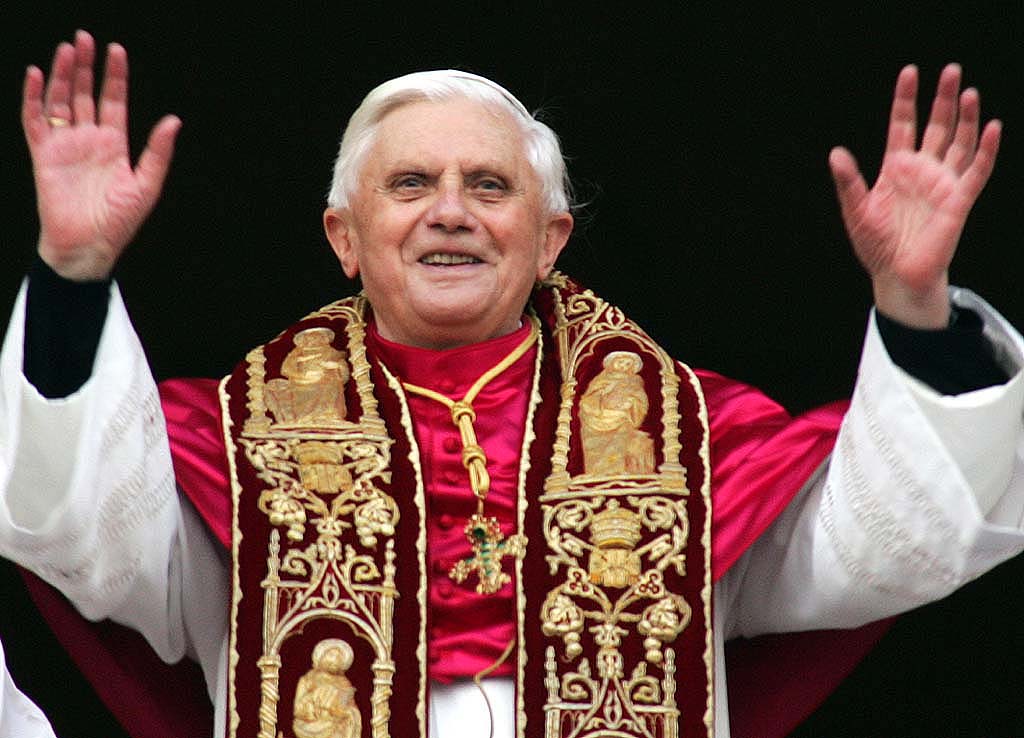
Each year, Pope Benedict gathers his former students together with him for a summer retreat that analyzes a specific topic. This year the topic was the New Evangelization as the Pope prepares for the Bishop's Synod on the New Evangelization in 2012. And along with this topic, the Pope made an interesting apology.

But, before we discuss the apology, let's review. The New Evangelization is the re-introduction of the Gospel to persons and cultures who were once Christian, but who have fallen away from an active living of the faith. For more on the New Evangelization, see our previous article.

Referencing a passage from Jeremiah and the theme of the New Evangelization, Pope Benedict prayed, "In this time of God’s absence when the earth of souls is arid and people do not yet know where the living water comes from, let us ask the Lord to show himself to us. Let us ask him to show those who are seeking the living water elsewhere..."

Then, Pope Benedict, who was surely still reflecting on World Youth Day, added, "Let us ask him, especially for young people, that the thirst for him may come to life within in them and that they may know where to seek the response."

Finally, the apology, "And let us, who have been acquainted with him since the days of our youth, ask forgiveness because we bring so little of the light of his face to others, and emanate so feebly the certainty that 'he is, he is present and he is the great and complete reality that we are all awaiting'".

The apology is striking. It is easy to make evangelization a extra-curriculur activity in the Catholic Church and have the attitude that "some are involved in Knights of Columbus, some help out with the Church festival, and some evangelize." In the end, evangelization is not an option; it is a requirement of our Baptism and Confirmation.


Failing to do so should cause all of us to repent.


For the full speech, click here.


Wednesday, September 7, 2011

The Crux - To Preach Christ Crucified

The Christian missionary Jim Elliot once said, “Lord, make me a crisis man. Let me not be a mile-post on a single road, but make me a fork that men must turn one way or another in facing Christ in me.”

How do we become crisis men and women? How do we live in such a way that people see Christ in us? How do we articulate who Christ is in a way they can understand? These are the ultimate questions of evangelization and questions that FOCUS continues to ask as we encounter thousands of college students each year.

One concrete effort in this area is FOCUS' new Bible study, The Crux. The Crux is a five-week study designed to give the participant the opportunity to understand the person of Jesus Christ. The climax of the study is an invitation for participants to make Jesus Christ the center of their lives.

The title of this study comes from the Latin word crux which means “cross.” It follows the example of St. Paul, “to preach Christ crucified” so that others may come to know the love that God has for us (1 Corinthians 1:23). The word crux today also refers to a place of decision or turning point.

In many ways, it is designed to live out Jim Elliot's quote about making us forks rather than mile posts. We want this study to be an experience where the participants can gaze upon the cross of Jesus Christ and come to a decision about Him in their own lives. Presenting the person of Jesus Christ within the context of a Bible study allows the person to not only hear about Jesus Christ in Scripture, but to hopefully see the person of Christ in their leader and others in the study.

After testing out this study last year, this is our first year "officially" using it out on campus. Anyone can download the study for free on FOCUSequip.org: http://bit.ly/FOCUSequipTheCrux


Have you seen The Crux yet?

What do you think?

Monday, August 22, 2011

The Ultimate Relationship

The Ultimate Relationship is a tool you can use to share the Gospel clearly and simply. The presenter walks a person, or “listener,” through a step-by-step presentation. The listener is able to understand what the Gospel message is and thus take the opportunity to commit or re-commit his or her life to Jesus Christ.

The booklet has four main messages:

1. God created us for a relationship with Him

2. Our relationship is broken through sin

3. Jesus restores our relationship with the Father

4. We have the choice to accept or reject this offer


Why use the Ultimate Relationship?

Too often we assume that certain people have already given their life to Christ or that they have actually heard the Gospel before. We must never make this assumption. Fr. Raniero Cantalamessa, preacher to the papal household, says this,

“I can see from my own experience that even if I speak of many beautiful concepts, nothing seems to happen. We must proclaim Jesus as Lord and Savior, helping people to grasp what it means to have Jesus as their Savior — not in a theoretical way, but that every day they have a Savior, someone who will lift them from their fatigue of the day, of their sin, and their mistakes, and who renews them. He saves us. When you proclaim this living, crucified and risen Jesus, something always happens.”

Many of us desire to share the Gospel with others, but we return to a common excuse: I just don’t know how. The Ultimate Relationship takes this excuse out of the equation. The booklet gives you an opening to share the Gospel. It helps you to know what to say. It is easy to present. It helps you to stay on topic. It enables you to be brief, prepared, and confident. And finally, it can be given away to the listener at the end. If we fail to share the Gospel with others, we can’t use the excuse that we don’t know how to share it.

Who can I use the Ultimate Relationship with?

Strangers

Acquaintances

Friends and family members

Bible study members

Disciples

Yourself

To continue reading this article and to learn more about how to use the Ultimate Relationship, click here and then click on the article entitled, The Ultimate Relationship.

Friday, August 19, 2011

What is the New Evangelization? The answer might surprise you

The term “The New Evangelization” is thrown around in many Catholics circles today, but what exactly does it mean?

It is believed that Blessed John Paul II first used the term in 1983 in an address to Latin American Bishops. He would later bring this term to the attention of the entire Church. Perhaps, the most clear definition of the New Evangelization is in his encyclical, Redemptoris Missio. In section 33 of this encyclical, Blessed John Paul II describes three different situations for evangelization: mission ad gentes, Christian communities, and the new evangelization.

Mission ad gentes: Latin for “to the nations.” This is a situation where “Christ and his Gospel are not known.”

Christian communities: “In these communities the Church carries out her activity and pastoral care.” This is the ongoing evangelization of those “fervent in the faith.”

New Evangelization: So, what is the new evangelization? Blessed John Paul II describes a situation between the first two options “where entire groups of the baptized have lost a living sense of the faith, or even no longer consider themselves members of the Church, and live a life far removed from Christ and his Gospel. In this case what is needed is a ‘new evangelization’ or a ‘re-evangelization.’”

The new evangelization pertains to a very specific group of people: fallen-away Christians. For most Catholics in the western world, we see the need for this type of evangelization all around us. Everyone knows someone who was once baptized but who no longer practices the faith. Blessed John Paul II wanted the faithful to clearly recognize this problem and then try to solve it.

FOCUS (The Fellowship of Catholic University Students) aims to answer the John Paul II’s call for the new evangelization. On college campuses across the nation, college students are falling away from their faith. Statistics show that just 15% of Catholics aged 18-25 attend Church on a weekly basis. FOCUS lives out the new evangelization on the college campus because of this critical age demographic.

Pope Benedict has continued the mission of the new evangelization in his pontificate. In 2010, Pope Benedict established The Pontifical Council for the New Evangelization. In 2012, he declared a Bishops’ Synod to discuss the New Evangelization. We should be hearing much more about this topic in the years to come. Below are some key quotes on the New Evangelization by Blessed John Paul II and Pope Benedict. For more, check out the full documents of the resources quoted below.

"I sense that the moment has come to commit all of the Church's energies to a new evangelization and to the mission. No believer in Christ, no institution of the Church can avoid this supreme duty: to proclaim Christ to all peoples" (Bl. John Paul II, Redemptoris Missio, no. 3).

"To this end, it is more necessary than ever for all the faithful to move from a faith of habit, sustained perhaps by social context alone, to a faith which is conscious and personally lived. The renewal of faith will always be the best way to lead others to the Truth that is Christ" (Bl. John Paul II, Ecclesia in America, no. 73).

"Look to the future with commitment to a New Evangelization, one that is new in its ardor, new in its methods, and new in its expression" (Bl. John Paul II, Address to the Latin American Bishops).

"The new evangelization in which the whole continent is engaged means that faith cannot be taken for granted, but must be explicitly proposed in all its breadth and richness" (Bl. John Paul II, Ecclesia in America, no. 69).

"Our own time, then, must be increasingly marked by new hearing of God’s word and a new evangelization. Recovering the centrality of the divine word in the Christian life leads us to appreciate anew the deepest meaning of the forceful appeal of Pope John Paul II: to pursue the mission ad gentes and vigorously to embark upon the new evangelization, especially in those nations where the Gospel has been forgotten or meets with indifference as a result of widespread secularism" (Pope Benedict XVI, Dei Verbum, no. 122).